
I am an Associate Professor in the School of Computer Science at the University of Nottingham in UK. The university of part of the Russell Group, which includes top UK universities like Cambridge and Oxford. I am the co-director of School’s Visualisation Research Group (VisTAG), and an organiser of the Visualisation Interest Group at the Alan Turing Institute, UK’s national institute for data science and artificial intelligence. Recently, I also take on the role of chair of the UK branch of the Eurographics (the largest professional body for Computer Graphics in Europe) and the convenor of the Generative AI Nottingham (GAIN) to promote the generative AI around Nottingham.
My main research interest is Data Science, particularly Data Visualisation, i.e., presenting data visually to facilitate pattern discovery using human cognition and domain knowledge (some examples). Currently I focus on human-centred AI, particularly human-AI collaboration or teaming, as I believe to get the best results user and Machine Learning should work together. I published widely on these topics and organised many related events. My current work focuses on building the interactive visual interfaces between users and ML/AI systems.
I have worked on a wide range of data science projects (funded), both academic and consulting. The total project budget is over £12 million, and supported by both the UK/EU research council (such as EPSRC and EU Framework Program) and government (such as Ministry of Defence/Dstl and Department of Homeland Security) and industry (such as Microsoft and British Telecom).
If you are a company or academic that wants to discuss anything visualisation and human-centred AI, please drop me an email at kai.xu@nottingham.ac.uk.
If you are a student looking for an intern or PhD, please see the Projects page for the possible project ideas and scholarship opportunities. You can see how the student projects are usually run here.
Funding
- RAMP VIS – Visual Analytics for Covid-19 (2021-2022, £430,000)
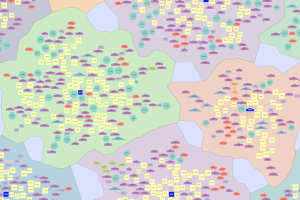 EPSRC, 2021-2022, £430,000 This is a collaborative efforts with many visualisation researchers across the UK to provide visual analytics support in the fight against Covid-19. It started as a volunteer… Read more: RAMP VIS – Visual Analytics for Covid-19 (2021-2022, £430,000)
 - God, the Oracle, and the Nightclub Bouncer: Can human dignity be modelled in an AI-based decision support system for post-Covid health certification (2020-2021, £50,000)
 Funder: ESPRC Network Plus SPRITE+ Date: 2020 – 2021 Funding: £50,000 Partner: Birmingham City University, King’s College London, Cardiff University, University of Exeter, Trilateral Research Ltd. In this project we… Read more: God, the Oracle, and the Nightclub Bouncer: Can human dignity be modelled in an AI-based decision support system for post-Covid health certification (2020-2021, £50,000)
 - Behaviour analytics for defence and security (2019, £80,000)
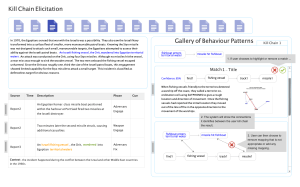 Funder: Defence Science and Technology Laboratory (Dstl), UK Date: 2019 Funding: £80,000 Partner: MASS Ltd In this project, we use the human-machine teaming approach to design a new visual analytics… Read more: Behaviour analytics for defence and security (2019, £80,000)
Papers
- Visualization for epidemiological modelling: challenges, solutions, reflections and recommendations
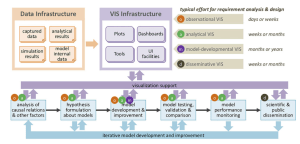 Philosophical Transactions of the Royal Society A: Mathematical, Physical and Engineering Sciences (Impact Factor 5.0) Open access: https://royalsocietypublishing.org/doi/full/10.1098/rsta.2021.0299 We report on an ongoing collaboration between epidemiological modellers and visualization researchers… Read more: Visualization for epidemiological modelling: challenges, solutions, reflections and recommendations
 - Visual Analytics of Contact Tracing Policy Simulations During an Emergency Response
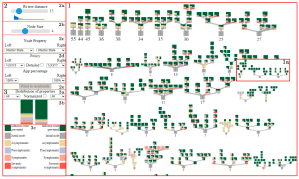 EuroVis 2022 🏆 Best Paper Honorable Mention/ Computer Graphic Forum Open access: https://onlinelibrary.wiley.com/doi/full/10.1111/cgf.14520 Epidemiologists use individual-based models to (a) simulate disease spread over dynamic contact networks and (b) to investi-… Read more: Visual Analytics of Contact Tracing Policy Simulations During an Emergency Response
 - Provectories: Embedding-based Analysis of Interaction Provenance Data
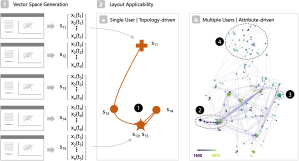 IEEE Transaction on Visualisation and Computer Graphics (TVCG) Understanding user behavior patterns and visual analysis strategies is a long-standing challenge. Existing approaches rely largely on time-consuming manual processes such as… Read more: Provectories: Embedding-based Analysis of Interaction Provenance Data
Services
- 1st IEEE Workshop on Visualization and Provenance Across Domains
 October 22nd, 2023 at IEEE VIS in Melbourne, Australia https://visxprov.github.io/ Our ambition is to build this into a series of workshops, targeting a different research community outside visualization each year,… Read more: 1st IEEE Workshop on Visualization and Provenance Across Domains
 - Dagstuhl Seminar: Human-Centered Approaches for Provenance in Automated Data Science
 Sep 10 – Sep 15, 2023, Dagstuhl, Germany https://www.dagstuhl.de/23372 This Dagstuhl Seminar aims to bring together an interdisciplinary group of researchers and practitioners, spanning Data Science (DS) and Machine Learning… Read more: Dagstuhl Seminar: Human-Centered Approaches for Provenance in Automated Data Science
 - VizTIG: The Visualization interest group at the Alan Turing Institute
 https://www.turing.ac.uk/research/interest-groups/visualization Visualization research and innovation has become critical to data science, it bridges the gap between digital data and human cognition. It is also emerging as an important methodology for… Read more: VizTIG: The Visualization interest group at the Alan Turing Institute
Projects
- Human-Centred Agentic Science: New Paradigm for Scientific Discovery
 Key technologies: Front end: React or Flutter and JavaScript-based visualisation such as d3.js and Observable. Back end: vector database (chroma). Machine learning: prompt engineering, agent orchestration framework (such as LangChain/LangGraph),… Read more: Human-Centred Agentic Science: New Paradigm for Scientific Discovery
 - Machine Learning for Automated Trading
 Key technologies: Front end: React or Flutter. Back end: (online) relational database, especially for time-series data. Machine learning: deep learning, anomaly detection, model tuning and performance tracking (such as MLFlow),… Read more: Machine Learning for Automated Trading
 - Vitality 2: Chat with Your Papers
 Key technologies: Front end: React or Flutter. Back end: vector database (chroma). Machine learning: LLM, RAG (such as RAGFlow), agent orchestration framework (such as LangChain/LangGraph), and MCP. You can see… Read more: Vitality 2: Chat with Your Papers
 Human-AI Collaboration
You must be logged in to post a comment.